Guides · Retiring soon & deals
How to invest in LEGO sets that are retiring soon, and why the deal is where you make your money
Updated · 7 min read · By the BrickStats team
Every LEGO set has an end. One day it drops off LEGO.com, shops sell their last boxes, and from then on the only way to get a sealed copy is from someone who bought one earlier. That is why retired sets tend to cost more than they did in the shop, and why collectors watch the “retiring soon” list so closely.
But the retirement itself isn’t where most of the money is made. It’s made at the till, months earlier, by the person who paid 20% or 30% less for the same box. This guide shows why, with BrickStats’ numbers, and how to put it into practice.
Why retiring sets are worth watching
LEGO keeps most sets on sale for one to two years, and big display sets for longer (a median of 2.6 years for sets over $250). It doesn’t announce retirement dates in advance. The most reliable public signal is the set appearing in LEGO.com’s own last-chance listings, which BrickStats checks every day. See the live retiring list.
After a set retires, supply only shrinks: sealed copies get opened, damaged or kept. Demand often keeps going, from people who missed it, from fans of a film or a ship, from builders who want a particular model. Across the 3,064 sets in BrickStats that retired from 2016 to 2024, that pushed the median sealed value to 1.63× retail, and 34% of them have at least doubled.
| 1 year | 1.32× |
|---|---|
| 5 years | 1.67× |
| 10+ years | 2.50× |
Sets retired 2016–2024. From our retirement guide.
Two things stand out. Growth is slow at first: a set that retired last year is typically worth about a third more, not double. And it isn’t universal: one in seven retired sets is worth less today than it cost in a shop. Retirement is a condition for a set to gain value, not a cause.
The deal is the part you control
You can’t decide how a set performs after it retires. You can decide what you pay for it. Because every gain is measured against your buy price, a discount at the start multiplies through everything that happens later:
| You paid | At 1.32× (1 year after) | At 1.63× (all retired sets) | At 1.63×, after 15% selling costs |
|---|---|---|---|
| Full retail | +32% | +63% | +39% |
| 10% off | +47% | +81% | +54% |
| 20% off | +65% | +104% | +73% |
| 30% off | +89% | +133% | +98% |
Arithmetic on BrickStats’ median multiples, not a forecast. Selling costs (marketplace and payment fees, shipping) are typically 10–20% of the sale price; 15% is used here.
Read the last column. At full retail, after fees, the typical retired set returns +39%. The same set bought 20% off returns +73%, nearly double, without picking a better theme or waiting a day longer. In the investing data, a 20–30% discount does more for your return than the gap between a strong theme and an average one.
It also protects you when a set disappoints. A set that ends at exactly retail is a loss after fees if you paid full price, and a small profit if you paid 30% less.
When retiring sets go on sale
- Late in a set’s life. Shops clear stock of lines they know are ending, especially big sets that tie up shelf space.
- Sales periods. Black Friday, January sales, summer sales, and shops’ own promotion weeks are when the deepest single-set discounts appear.
- Shop by shop, country by country. The same set can be 30% off at one retailer and full price at another, and the discount is often local: a UK deal says nothing about Germany.
- Briefly. Good prices on popular sets sell out in hours or days. A list you check once a month misses most of them.
That last point is why watching beats searching. Once a set is on the retiring list, most still trade around their retail price (a median of 1.00× on 23 October 2026), so a discount on one is genuinely worth acting on, but only if you hear about it in time.
Not every retiring set is worth buying
A low price doesn’t make a good buy if the set had nothing going for it. Sets that were on sale for years and discounted often are the ones collectors stockpiled, and a set everyone stockpiled is a set everyone sells. These large retired sets are still close to retail:
| Set | Theme | Retail | Sealed today | vs retail |
|---|---|---|---|---|
| Tree House (21318) | Ideas | $250 | $265 | +6% |
| R2-D2™ (75308) | Star Wars | $240 | $250 | +4% |
Against that, Colosseum (10276) was a huge display piece with no substitute, and has done very well. Things that have historically helped:
- A theme with a track record. Ninjago (2.40×), Speed Champions (2.32×), BrickHeadz (2.17×) and Ideas (2.05×) lead; Friends, Gear and Super Mario lag. Full table in the investing guide.
- Good value at retail. Sets under $0.08 per piece reached a median 1.75×; over $0.15 per piece, 1.51×. Every set page now shows its retail price per piece.
- No obvious replacement. A one-off design (an Ideas set, a big original model) holds up better than a ship LEGO is likely to make again.
- A box you can keep sealed. Used copies are worth a median 29% of sealed ones. Buy to keep closed, and store it flat, dry and out of the sun.
How to do it with BrickStats, step by step
- Start from the last-chance list. The retiring page shows what LEGO.com itself lists as retiring soon, checked every day, with retail price and today’s value side by side.
- Check the set page before you decide. Value against retail, price history, price per piece, and the “Retirement & value outlook” section, which reads the theme’s track record and the set’s value at retail against 3,000 retired sets.
- Name your price. Add the set to your wishlist in the app and set a target. BrickStats tells you when its market price reaches it. No app? Every set page has an email alert.
- Let BrickStats watch the shops. Today’s LEGO deals shows how many sets shops sell under LEGO.com’s price in your country; in the app you see the shop and the price, and a deal alert tells you when a set you want drops well under it.
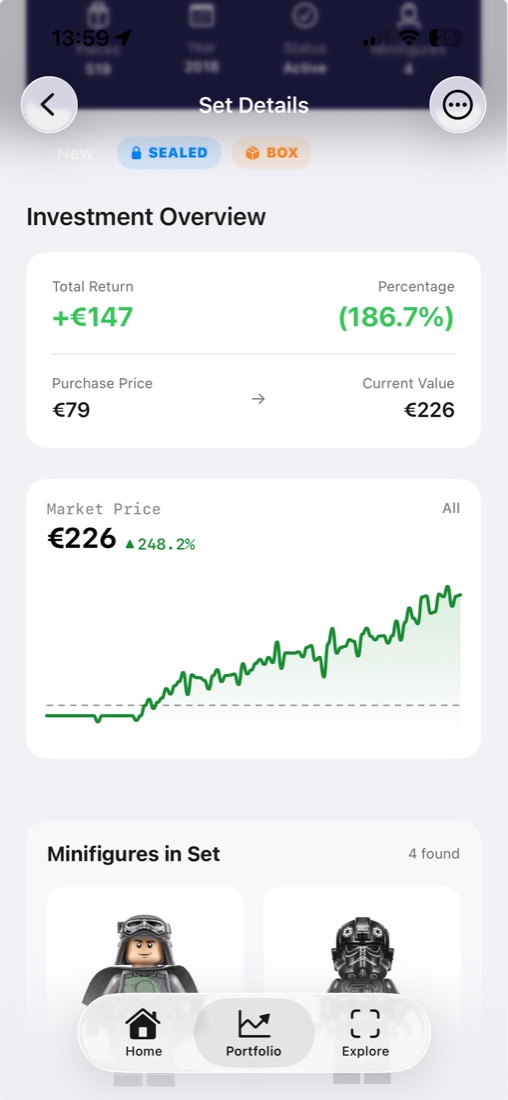
- Record what you paid. In the app, each set is a position: buy price, value today, and your return, so you can see whether the deal actually paid off.
- Decide your exit in advance. A target multiple or a time frame, before you buy. It stops you selling in the slow first year, or holding a set that has stopped moving.
On the list right now
Some sets on LEGO.com’s retiring list already trade above retail, which usually means they’re hard to find in stock: The Botanical Garden (21353) and The Endurance (10335). Others, like Volvo EC500 Hybrid Excavator (42215), can still be bought at or below the shop price. The full, current list is on the retiring page, and our 2026 list adds the sets that have already gone.
- LEGO The Botanical Garden (21353-1): retail $330, sealed today $465
- LEGO The Endurance (10335-1): retail $270, sealed today $375
- LEGO Volvo EC500 Hybrid Excavator (42215-1): retail $430, sealed today $414
- LEGO NASA Artemis Space Launch System (10341-1): retail $260, sealed today $390
Frequently asked questions
Is it a good idea to buy LEGO sets that are retiring soon?
It can be. Retired sets in BrickStats data are worth a median 1.63× retail, and while a set is on LEGO.com’s retiring list it usually still costs about retail. But 14% of retired sets trade below retail, the first year after retirement is slow (1.32×), and selling costs take 10–20%. Buying at a discount makes the biggest difference.
How much do LEGO sets go up after they retire?
In BrickStats data for sets retired 2016–2024, the median is 1.32× retail one year after retirement, 1.67× after five years and 2.5× after ten or more. One in three sets is still at or below retail in the first year.
How much does buying on a deal change the return?
A lot. If a set ends at the median 1.63× retail, buying at full price is a 63% gain; at 20% off it’s 104%, and at 30% off 133%. After 15% selling costs those become 39%, 73% and 98%.
When are retiring LEGO sets discounted?
Mostly late in a set’s life, when shops clear stock, and in sales periods such as Black Friday and January sales. Discounts vary by shop and by country and good ones sell out fast, which is why a price alert works better than checking by hand.
How do I know which LEGO sets are retiring?
LEGO doesn’t publish dates in advance. The most reliable signal is LEGO.com’s own last-chance listings, which BrickStats checks daily and shows on its retiring page.
How does BrickStats find LEGO deals?
It reads shop prices every day and counts a deal only when a shop sells a set at least 5% under its LEGO.com price in the same country, at a price read in the last three days. The website shows how many sets are on sale and by how much; the BrickStats app shows the shop and the price, and can alert you when a set you want drops.