Guides · Pricing guide
How much is my LEGO worth? How to track LEGO set prices and collection value
Updated · 6 min read · By the BrickStats team
Search any LEGO set and you will find a price. Search three places and you will usually find three different prices, sometimes twice apart. That isn’t because LEGO is unknowable. It’s because most numbers you see online answer a different question than the one you are asking.
This guide explains which number actually tells you what your LEGO is worth, why condition matters more than almost anything else, and how to keep a live value for a whole collection without a spreadsheet. Every figure below comes from BrickStats’ own price data, taken on 23 October 2026.
Asking prices are not values
The most common mistake in LEGO pricing is treating a listing as a value. Anyone can list a sealed set for any price, and the highest asks tend to sit unsold for months, which is exactly why they are still there for you to find. Average every listing together and those stale asks drag the number up. That is how a collection can “be worth” far more on paper than anyone would pay for it.
Here is what that spread looks like on real sets. On 23 October 2026 the cheapest clean sealed listing for Millennium Falcon (75192) was about $625 delivered and the most expensive was about $2,468. The median of what buyers could actually get one for was $1,175. Quote the top of that range and you would overstate the set by more than double.
| Set | Cheapest clean listing | Highest listing | BrickStats value |
|---|---|---|---|
| Millennium Falcon (75192) | $625 | $2,468 | $1,175 |
| LEGO® Titanic (10294) | $700 | $1,199 | $905 |
| Tree House (21318) | $171 | $359 | $265 |
Range after removing listings that aren’t the set itself and trimming outliers. Values are the median of the cheapest sealed listings.
If you are about to sell something valuable, check completed sales as well: most marketplaces let you filter search results to items that actually sold. Those are the strongest evidence of a price, and they should land close to a fairly built median of current listings. If they don’t, trust the sales.
Sealed vs used: the biggest factor in what your set is worth
Collectors pay for certainty. A factory-sealed box guarantees every piece, every minifigure and the instructions, and it can be resold again as sealed. A built or opened set can’t promise any of that, so it trades in a different, much cheaper market.
Across the 8,459 sets where BrickStats has both a sealed and a used price (sealed above $20), the median used copy is worth 29% of a sealed one. The middle half of sets fall between 18% and 42%. In plain terms: opening a set typically gives up half or more of its collector value.
| Set | Retail | Sealed | Used | Used as % of sealed |
|---|---|---|---|---|
| Imperial Star Destroyer (75252) | $784 | $1,612 | $562 | 35% |
| Mos Eisley Cantina (75290) | $416 | $550 | $265 | 48% |
| Typewriter (21327) | $250 | $375 | $178 | 47% |
| NASA Space Shuttle Discovery (10283) | $200 | $280 | $124 | 44% |
| Tree House (21318) | $250 | $265 | $116 | 44% |
| R2-D2™ (75308) | $240 | $250 | $80 | 32% |
| Galaxy Explorer (10497) | $100 | $127 | $69 | 55% |
Used means complete with instructions; missing pieces or minifigures lower it further.
Two practical consequences follow. If a set is for display, buy it used and save most of the collector premium. If it is a store of value, keep it sealed, and store it somewhere dry and dark: crushed corners and sun-faded boxes are priced like used sets by serious buyers.
New vs retired: when prices start to move
While LEGO still makes a set, its price has a ceiling: nobody pays much above retail for something they can order from LEGO.com tomorrow, and frequent discounts push it below. Of the sets LEGO.com currently lists as available, the median trades at exactly 1.00× retail on the secondary market.
Retirement removes that ceiling. From then on supply only shrinks, as sealed copies get opened, and the price is set by collectors who missed it. Colosseum (10276) retired in November 2023 at $550 retail and sealed copies now go for $1,699. Not every set does that, and our retirement guide shows how values typically develop in the years after a set leaves shelves.
- LEGO Colosseum (10276-1): retail $550, sealed today $1,699
- LEGO AT-AT™ (75313-1): retail $850, sealed today $1,630
- LEGO Imperial Star Destroyer (75252-1): retail $784, sealed today $1,612
- LEGO Police Station (10278-1): retail $200, sealed today $419
How to look up what a LEGO set is worth
- Find the set number. It is printed on the box front, the instruction booklet cover and LEGO.com. Names repeat across years (there are several sets called “Millennium Falcon”); numbers don’t.
- Decide the condition honestly. Sealed means factory-sealed and undamaged. Anything opened is used, even if it has never been built.
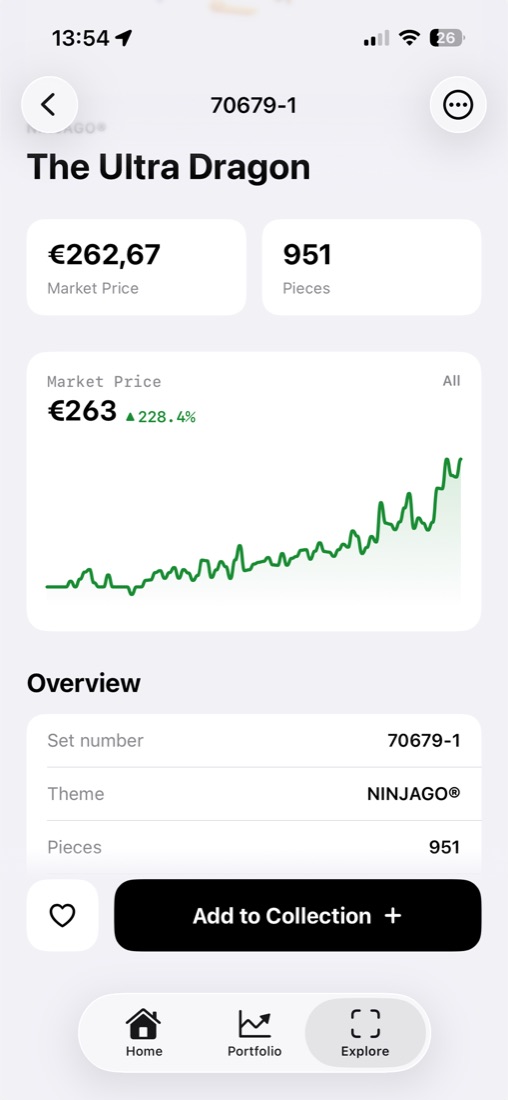
- Look up the value for that condition. Every set page on BrickStats shows the sealed value, retail price, the gap between them, and its price history. For example: Imperial Star Destroyer 75252.
- Check the trend, not just the number. A price history chart tells you whether today’s value is a plateau, a spike or a slide.
- For a big sale, confirm with completed sales. Sold listings are the final word on a specific copy.
How to track the value of a whole LEGO collection
Looking up one set is easy. Keeping a live value for fifty is where spreadsheets fall apart: prices move every day, and a total on its own doesn’t tell you whether you are up or down. A useful collection tracker does four things:
- Reprices every set daily from the market, separately for sealed and used.
- Records what you paid and when, so it can show your gain in dollars, as a percentage, and per year held.
- Keeps realized and unrealized apart. When you sell, the profit moves to a running realized total instead of disappearing.
- Shows where the value sits: by theme, by release year, and how much is in retired sets.
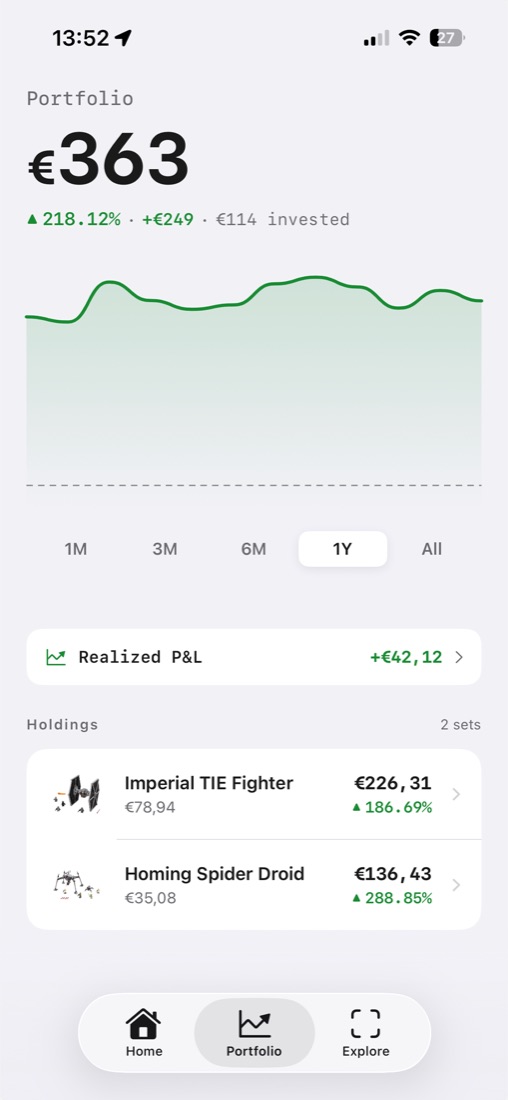
That is what BrickStats does. Add a set by searching or by scanning the box with your camera, enter what you paid, and the app keeps the value current. If you are choosing between apps, our collection tracker checklist covers what to look for.
Frequently asked questions
How much is my LEGO set worth?
A LEGO set is worth what a buyer will actually pay for a copy in the same condition. Look it up by set number and condition: BrickStats shows the sealed value, used value, retail price and price history for 22,000+ sets, updated daily.
Is opened LEGO worth less than sealed?
Yes, by a lot. Across 8,459 sets BrickStats prices both ways, a used copy is worth a median of 29% of a sealed one. Collectors pay a premium for the guarantee that a factory-sealed box is complete.
Why do LEGO price sites show different values?
Mostly because they measure different things. An average of all asking prices is pulled up by overpriced listings that never sell; a median of the cheapest clean listings, or of completed sales, is much closer to what a set really goes for. Condition (sealed vs used) is the other big reason.
Do LEGO sets go up in value?
Many do after retirement, but not all. While a set is on sale its price stays near retail. In BrickStats data, retired sets are worth a median of 1.3× retail one to two years after retirement, rising with time, but some trade below retail for years.
How often are LEGO prices updated?
BrickStats reprices every set daily. Each set page shows its latest value and full price history.
Is there a free LEGO value tracker?
BrickStats is free for up to 5 sets, with no trial or card required. Pro removes the limit and adds full price history, the scanner and portfolio charts.