Guides · LEGO deals
How to find LEGO deals: why checking the shops by hand doesn’t work, and what does
Updated · 6 min read · By the BrickStats team
Everyone who collects LEGO has a story about the deal they missed: the big set that was 30% off for one weekend at a shop they never check, gone by the time a friend mentioned it. The deals are real. Finding them is the hard part.
This guide explains why LEGO deals are so hard to catch by hand, why the price you pay matters more than almost anything else if you buy to collect or invest, and how BrickStats does the daily checking for you.
What counts as a real LEGO deal
A “sale” banner is not a deal. Plenty of shops show a crossed-out price that nobody ever paid, or a discount off an inflated list price. The only honest yardstick for a LEGO set is LEGO’s own price for it on LEGO.com, in your country and your currency. A set that costs €59.99 on the German LEGO store is a deal in Germany when a shop sells it for meaningfully less, not when it is “20% off” a price that was never real.
Two more things are worth leaving out. Prices that depend on a voucher code, a loyalty card, a membership, cashback or being a new customer are not the price everyone pays at the checkout. And a price you saw last week says nothing about today: shop prices on LEGO change constantly.
Why finding deals by hand is so hard
- There are many shops. Toy shops, department stores, online marketplaces and supermarkets all sell LEGO, and each sets its own prices.
- Deals are local. A UK discount says nothing about Germany, and a Dutch shop’s price doesn’t help a buyer in France. You have to check the shops that actually deliver to you.
- Deals are short. Discounts on popular sets sell out fast, and shops change prices daily, sometimes several times a day. A check once a week misses most of them.
- The yardstick moves too. LEGO’s own price differs by country and changes over a set’s life, so even knowing whether a price is good means looking up LEGO.com as well.
- Sale periods are crowded. Black Friday and the January sales bring the deepest discounts, but also thousands of fake ones, and the time to sift through them.
Put numbers on it. Say you want 10 sets and there are 6 shops that deliver to you. That is 60 product pages a day, each one to find, open and compare with LEGO.com’s price in your country. At a minute a page, that’s an hour every day, about 7 hours a week, just to stand still. Add a second country, or a bigger wishlist, and it doubles. Skip a day, and that is the day the deal was there.
Why buying below the market matters
If you buy LEGO to keep sealed, collect or invest, the price you pay is the one lever you fully control. You can’t decide how a set performs after it retires. You can decide whether you paid full price for it.
Across the 3,064 sets in BrickStats that retired from 2016 to 2024, the median sealed set is now worth 1.63× its retail price. Every gain is measured against what you paid, so a discount at the start multiplies through everything after:
| You paid | Gain | After 15% selling costs |
|---|---|---|
| Full retail | +63% | +39% |
| 10% off | +81% | +54% |
| 20% off | +104% | +73% |
| 30% off | +133% | +98% |
Arithmetic on BrickStats’ median multiple for sets retired 2016–2024, not a forecast. Selling costs (fees and shipping) are typically 10–20% of the sale price. More in the investing guide.
Twenty percent off nearly doubles the return after costs, without picking a better theme or waiting a day longer. It also protects you when a set disappoints: about one in seven retired sets still trades below retail, and a deal turns some of those from a loss into a small gain.
How BrickStats finds LEGO deals for you
BrickStats does the daily checking so you don’t have to. Every day it reads shop prices for LEGO sets, country by country, and puts each one next to the set’s own price on LEGO.com in that country.
- Shop prices, read daily. Prices from shops that sell LEGO in your country, refreshed every day.
- Measured against LEGO’s own price. A set counts as on sale only when a shop sells it at least 5% under its LEGO.com price in the same country, at a price read in the last three days. Voucher, membership and cashback prices are left out.
- Shop alerts for the sets you want. In the BrickStats app, turn on a shop alert for a set and you get a notification when a shop sells it under LEGO’s price, 10% under by default, or whatever discount you choose. You hear again only if it gets cheaper.
- Price alerts on the market too. Add sets to your wishlist with a target price, and BrickStats tells you when the set’s market value reaches it, useful for sets LEGO has already retired.
On the website, today’s LEGO deals shows how many sets are on sale in your country and by how much, and every set page shows its deals where there are any. The shop and the price are in the app, because a shop price copied off a web page is out of date by the next morning.
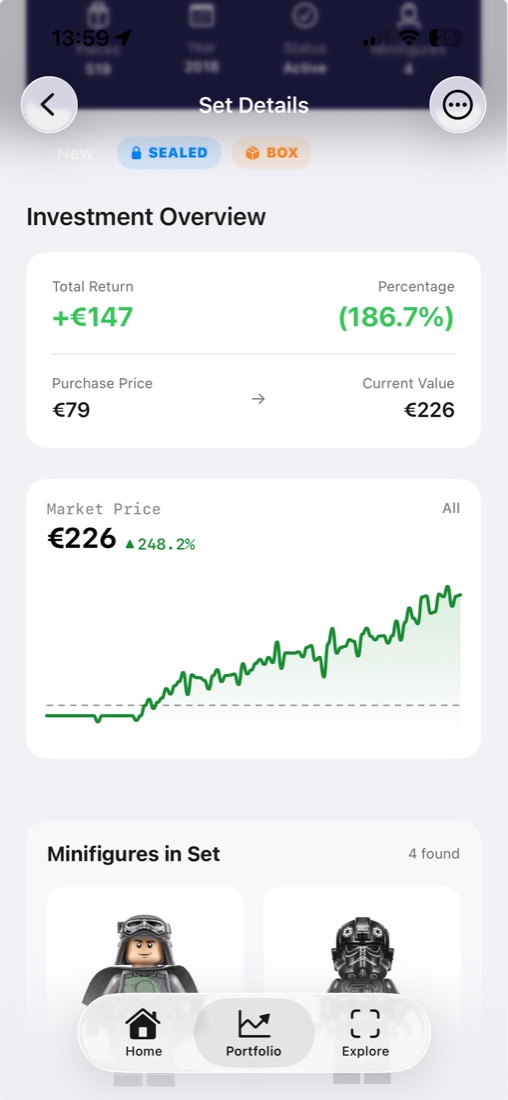
A routine that works
- Pick the sets you actually want. Start from the retiring list if you buy to invest: those sets are in their last months at retail.
- Check the set page. Value against retail, price history and the retirement outlook tell you whether the set is worth chasing at all.
- Turn on a shop alert for each one in the app, with the discount you’d buy at.
- Buy when the alert comes, not when a banner says “sale”.
- Record what you paid in the app, so the gain is measured from your real price.
Frequently asked questions
How do I find real LEGO deals?
Compare the shop price with the set’s own price on LEGO.com in your country, ignore voucher and membership prices, and check often, because good deals are local and short. BrickStats does this daily and sends a shop alert when a set you want drops under LEGO’s price.
When are LEGO sets cheapest?
The deepest discounts tend to come late in a set’s life, when shops clear stock, and in sales periods such as Black Friday and the January sales. But a good deal can appear on any day, at one shop in one country, which is why an alert works better than checking on fixed dates.
Is it worth buying LEGO on sale to invest?
The price you pay is the part of the return you control. In BrickStats data the median retired set is worth 1.63× retail; bought at full price that is a 63% gain, bought 20% off it is 104%. After typical selling costs of 15%, 39% becomes 73%. Past results, not a forecast.
How does the BrickStats deal tracker work?
It reads shop prices every day and counts a deal only when a shop sells a set at least 5% under its LEGO.com price in the same country, at a price read in the last three days. In the app you see the shop and price, and a shop alert notifies you when a set you want drops under LEGO’s price, 10% by default.
Is the BrickStats deal tracker free?
The deal counts on the website are free. In the app, a shop alert on one set is free; Pro adds shop alerts on every set you want.